Asia / Uzbekistan

Bukhara.

Places to go. A little room to wander.

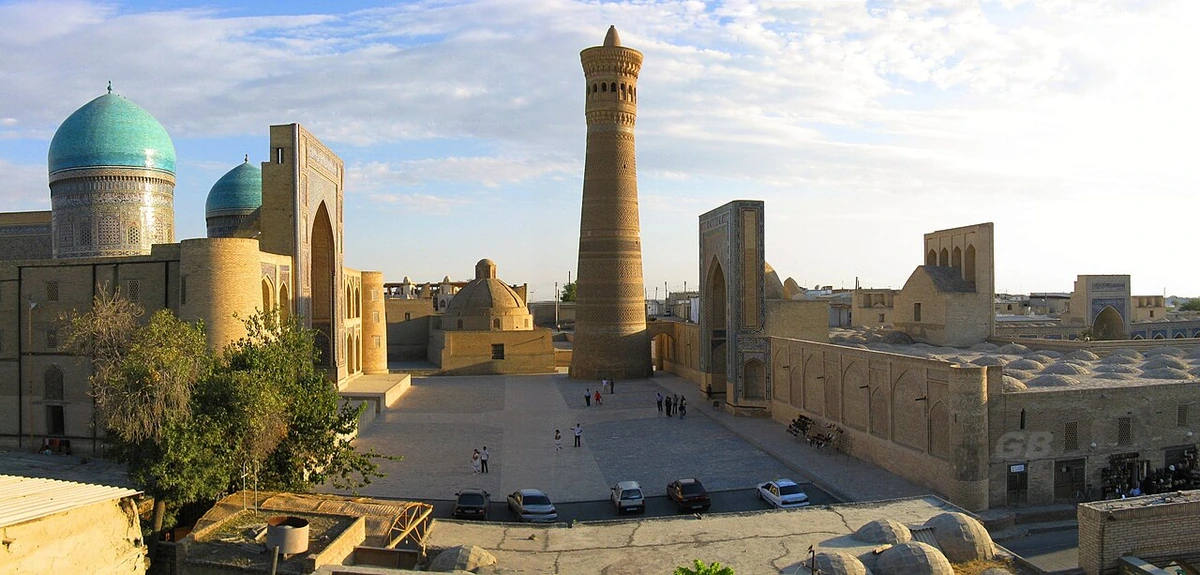
A local view near Bukhara, Uzbekistan
A local view near Bukhara, Uzbekistan. Photograph by Euyasik · CC BY-SA 3.0 · Resized proportionally, EXIF orientation applied, converted to high-quality WebP (quality 92); no content edits.

THE SHORTLIST

A few places worth your time.

01Culture · DAY 1 IDEA

Sarrafon

Synagogue

There's been a substantial Jewish community in Bukhara since the 8th century. This synagogue was built around 1640, in legend as part of the peace deal with the widow who owned the Lyab-i Hauz site. Eventually it was returned, but the Jews had emigrated to Israel and the US so it was never again in use. It's now a small museum.

Allow about 90 minutes · planning estimate

Map Source
02Culture · DAY 1 IDEA

Mehtar Ambar 55

Magok-i-Attari Mosque

The oldest surviving mosque building in Central Asia, dating back to the 800s, reconstructed in the 1500s and now a carpet museum. "Magoki" means a pit, and it was in a dip in the ground when built over a former Zoroastrian temple, and has sunk further. It's now 6 metres below ground level, and its domes barely reach the street. "Attar" means perfume as there once was a perfume market nearby. The 12th-century main facade is very impressive.

Allow about 90 minutes · planning estimate

Map Source
03Culture · DAY 1 IDEA

Registan

Ark Citadel

Citadel or kremlin that contained palaces, temples, barracks, offices, the mint, warehouses, workshops, stables, an arsenal; everything a ruler might want for his comfort, and for the misery of his captives. It's a heptagonal enclosure (said to be patterned on the constellation of Ursa Major) with earth brick walls up to 20 m tall. It was built and re-built for millennia, taking its present form under the Shaybhanid dynasty around 1500. You enter through the grand west gate and see the museum, throne room, royal courts and mosque. The eastern half has not been restored.

Allow about 90 minutes · planning estimate

Map Source
04Culture · DAY 2 IDEA

Bukhara

Chashma-Ayub Mausoleum

The name means "spring of Ayub" - Job - who in legend struck the ground with his staff and out gushed a spring. Bukhara was one of several cities where he performed this feat and was subsequently buried; the oldest authenticated burial here was of Khwaja Hafiz Gunjari in 1022 AD. The entrance portal is from 1208, but the mausoleum is from 1380 in the reign of Timur, with a Khwarazm-style conical dome.

Allow about 90 minutes · planning estimate

Map Source
05Outdoors · DAY 2 IDEA

Bukhara

Mausoleum of Saif ed-Din Bokharzi & Bayan-Quli Khan

Sayf al-Din was a 13th-century poet, sheik and mystical theologian who settled in Bukhara as a tutor. He died in 1261 and his tomb became a Sufi shrine. Bayan Qulï was a local ruler much influenced by Sayf al-Din and was buried alongside in 1358. Mausoleums were then built to both, and a large religious complex developed, in what was then the separate village of Fathabad. The rest of the complex has disappeared.

Allow about 60 minutes · planning estimate

Map Source

A note before you go. Start with Synagogue, then decide whether Magok-i-Attari Mosque deserves a separate visit rather than rushing both. The suggested days are an editable grouping, not a timed tour. Visit allowances exclude transfers, meals and queues; confirm the exact entrance and current visiting arrangements for Mausoleum of Saif ed-Din Bokharzi & Bayan-Quli Khan before setting off.

Reference material retrieved 2026-10-19. Suggested days and time allowances are editorial starting points. Check the linked visitor information for opening hours, access, and reservations.

BEFORE YOU SET OFF

A more practical kind of plan.

Getting your bearings

A swarm of small buses serves the city. They're sometimes described as marshrutkas or dolmuşes but they have fixed stops and run to a fixed timetable, though its details are known only unto Allah. Pay the driver on exit if there isn't a conductor. The only bus through Old Town is #9, running east-west past the Lyab-i-Hauz complex. Others run to points 1 km out, for instance #60 west side of the complex and #378 east side. Old Town itself is compact and mostly pedestrianised, so walking is the best way to explore.

Build a route that makes sense

Synagogue and Magok-i-Attari Mosque are about 0.2 km apart in a straight line. Use the route link to compare the actual streets or transport connections before putting both in the same morning; the measurement is not a walking distance or a transfer estimate.

A LITTLE STRUCTURE. ROOM FOR DISCOVERY.

Your Bukhara plan.

Add a few stops, choose your days, and leave space between them.

My saved trips
Location, map & reference details

Find your bearings.

Country
Uzbekistan
Area
Bukhara
Time zone
Asia/Samarkand
Coordinates
39.7703, 64.4307

Geographic reference: GeoNames, CC BY 4.0.

Bukhara

Loading this map connects to OpenStreetMap.

Visitor information & sources

Reference credits & reuse

This city guide includes selected, abridged material by Wikivoyage contributors, adapted under CC BY-SA 4.0. The adapted guide text is available under the same license; photographs and website design retain their separate terms. Selected and abridged reference descriptions; operational prices and timetables omitted. Elsewhere added the shortlist, geographic grouping and planning notes.

Reference material retrieved 2026-10-19. It is community-edited background, not firsthand reporting or a live opening-hours service.

KEEP EXPLORING

More places in Uzbekistan.

Browse the country
A WORLD OF POSSIBILITIES

Where to next?

Search 600 places across 100 countries.