
Make this your Auckland itinerary
THE SHORT VERSION
- Treat tūpuna maunga as culturally significant places.
- Remain on marked routes and outside sacred crater areas.
- Choose one park landscape unless you have time for a considered transfer.
Understand what kind of landscape you are entering
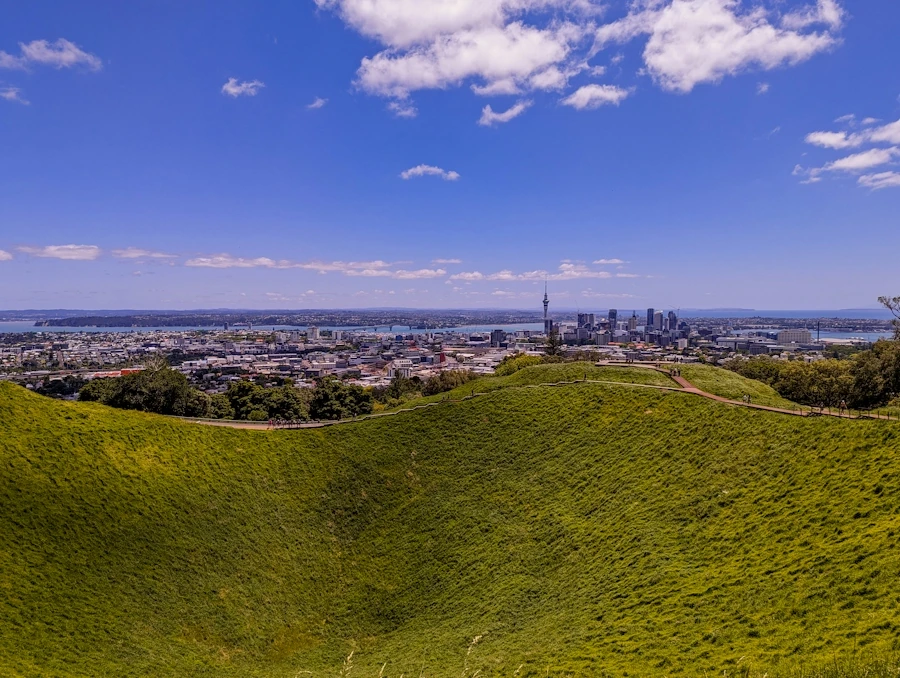
Auckland’s volcanic cones are easy to describe as viewpoints, but that description is incomplete. Places such as Maungawhau are tūpuna maunga, ancestral mountains with cultural significance as well as geological interest. I would begin with that understanding and treat the view as one part of the visit. The route, interpretation, and restrictions matter, not just the highest point you can reach.
Choose Maungawhau as the main outing or build a separate visit around Cornwall Park and the neighboring maunga. Combining both can work with a sensible transfer, but it is not necessary for a satisfying day. Two green areas on a map can still be far enough apart to turn a relaxed walk into a transport exercise. Pick the landscape you most want to understand.
At Maungawhau, stay with the marked route
Follow current access information and the designated paths. The crater is not an invitation to descend for a more dramatic photograph. Auckland’s official guidance identifies it as a sacred area and asks visitors to stay on the paths. The boundary protects meaning and landscape at the same time. You do not need to stand in the middle of a feature to appreciate its scale.
Look outward from permitted viewing areas and then back at the ground. Terraces and other visible features can prompt questions about how people lived here, while interpretation provides context that a skyline alone cannot. Give that material time before moving on. It is easy to remember a distant tower; it takes a little more attention to understand the place from which you are looking.
Choose Cornwall Park for a broader green afternoon
Cornwall Park offers a different kind of outing, with lawns, trees, paths, and a working rural character within the city. Use its current visitor information to choose a circuit that suits your energy. Keep gates as instructed, give livestock space, and do not assume a grassy slope is available for any activity just because it appears open. The park’s ordinary management is part of what keeps the landscape enjoyable.
If you include the neighboring maunga, observe its own signs and cultural guidance rather than treating the entire area as one undifferentiated recreation ground. A broad park walk and a culturally significant summit ask for different kinds of attention. Let a picnic or cafe pause divide them if that helps everyone maintain interest and energy.
Use the view to make sense of the city
From a permitted viewpoint, pick a few features you can identify: another cone, a harbor direction, a neighborhood where you have already walked. This turns the panorama into a practical understanding of Auckland. You do not need to name every distant point. Noticing how land and water interrupt the urban fabric is enough to make the city feel more coherent.
End before the walk becomes a rush to a final photograph. A modest meal or drink after descending gives you time to absorb what you saw. The route back to transport is still part of the day, so leave enough daylight and attention for it. These landscapes reward visitors who see them as places with continuing significance, not merely platforms from which to collect an impressive skyline.
Begin with interpretation, then look outward
Maungawhau should be approached as a culturally significant maunga, not just as the nearest route to a skyline image. Read the current visitor guidance before traveling, including restrictions on vehicles and the available pedestrian approach. If a visitor interpretation facility is open, consider beginning there. Learning how the place is understood can change the way you look at the crater, terraces, and summit route. The view remains appealing, but it becomes one part of a landscape with a history and continuing meaning, rather than the sole reason you climbed.
Follow the designated path even when another line across the grass seems shorter. The crater is sacred, and official guidance asks visitors to remain outside it. An exposed surface or a gap in a photograph is not an invitation to enter. On the permitted route, pause where others can pass and look at the landform from several angles. You do not need to obtain a dramatic position at its edge. A careful view from the maintained route can make its scale clear while respecting the boundaries that make visiting possible.
If access requirements affect your group, examine the whole approach, not just the existence of a paved surface. A paved climb can still be steep. Ask about current mobility arrangements through official channels and choose a lower-level visit if that is the comfortable option. Do not make the summit a test of whether everyone participated properly. The wider area and interpretation may already offer the experience you wanted. An outing built around cultural and landscape understanding has more possible successes than one defined entirely by reaching a specific point.
Cornwall Park provides a different afternoon when you prefer a broader green circuit. Use the park’s own guidance to choose paths and any appropriate picnic area. Livestock, gates, and working management belong to the setting, so keep animals undisturbed and follow signs rather than treating the park like an unregulated field. If you add the neighboring maunga, switch back to its particular cultural and access rules. The fact that two areas adjoin does not make them one type of public space. Give each the attention its role requires.
From a suitable viewpoint, connect the panorama to places you already know. Identify a harbor direction, another cone, or the neighborhood where you are staying. This small exercise makes Auckland’s landscape practical rather than abstract. You might understand why a previous journey bent around water or why a distant ridge interrupts the city grid. End with enough time for an ordinary descent and a calm transfer. A cafe pause can provide the final chance to read or talk about what you noticed. Leave the maunga with a clearer sense of place, not just a higher camera angle.
A lower route can still tell a story
If the upper approach is unsuitable, do not assume the entire visit must disappear. Investigate the available interpretation and a lower public route that is appropriate for your group. You can learn about a maunga’s significance without making physical achievement the measure of attention. This is particularly useful when companions have different mobility, energy, or confidence on slopes. Agree on the shared part of the visit and use a comfortable meeting place if anyone chooses an additional permitted walk. The cultural landscape is not less important below the highest viewpoint, and a considered alternative can leave everyone with a clearer understanding rather than a memory of being left behind.
Sources & further reading
First published 18 October 2026. Page updated 19 October 2026. Planning references checked on 18 October 2026. The edition date above follows your device’s time zone; it does not indicate a new research check. Confirm current opening details and booking arrangements with the places you plan to visit.