
THE SHORT VERSION
- Keep the historic-center walk compact and choose one substantial cultural interior.
- Look above shopfronts for balcony details rather than rushing between famous buildings.
- Consider a chifa meal as part of Lima’s food story and preserve traffic margin for the return.
Arrive with one clear route
Lima’s historic center can become an exhausting outing if you approach it as every church, museum, and famous meal in a single day. I’d choose a compact route around Plaza Mayor, Jirón de la Unión, and one cultural interior, with lunch as a real stop rather than something squeezed between monuments. The old center is a living part of a large capital, and that mixture of commerce, civic activity, and historic fabric is more interesting than an imagined city frozen in the past.
Allow for the transfer from coastal accommodation, since traffic can change the practical length of the trip. Check current local guidance and any access restrictions around major civic spaces. Arrive in daylight with a charged phone, water, and a clear destination. A locally led walk can be useful if you want context and a confident route, but independent visitors can also enjoy a focused visit without trying to navigate every surrounding district. The important preparation is deciding what you actually want to understand.
Read Plaza Mayor as a civic space
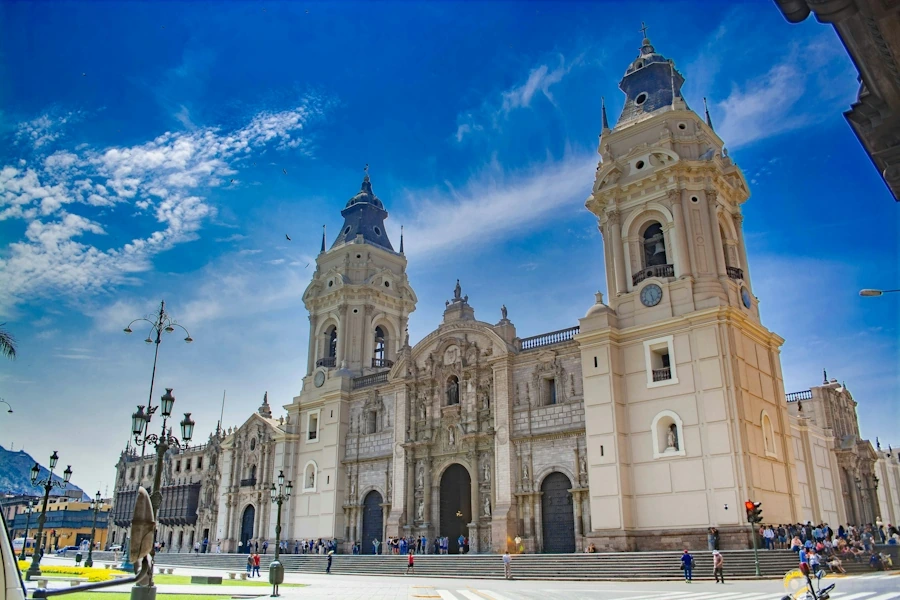
Plaza Mayor, also called Plaza de Armas, provides a strong starting point. Look at the relationships between the cathedral, government buildings, municipal architecture, and public space before moving straight toward an entrance. The square remains tied to civic life, so barriers or official activity may affect where you can go. Treat that as part of visiting an active capital rather than evidence that the sightseeing plan has failed.
If you enter the cathedral or another religious site, give the visit a respectful pace and follow photography and service restrictions. Read a little about the collection or architecture instead of moving from chapel to chapel without context. I’d choose a few details to study closely: carved work, a painted image, a change in material, or the relationship between a grand interior and the street outside. You do not need to memorize a chronology to appreciate how power, religion, and skilled labor have shaped the visible city.
Use the balconies to look up
The center’s balconies are a good reason to slow down between landmarks. From street level, they draw attention to the upper stories that travelers often miss while checking directions. Look for differences in enclosure, ornament, material, and how a façade meets the pavement. The interest lies in variation rather than finding one balcony that can stand for the entire city. A short block can reward more attention than a distant building visited only because it appeared on a list.
Jirón de la Unión gives the walk a clear axis, with the public streets linking major spaces and everyday commerce. Keep belongings secure in busy areas and stop out of the main pedestrian flow when consulting your phone. I’d make one or two brief detours only when they serve a particular interest. A compact route lets you look closely; too many turns can leave you concentrating entirely on navigation. When you reach a square, take a seat and notice how the pace changes from the connecting street.
Choose one substantial cultural interior
San Francisco is a familiar option to investigate for religious architecture and the associated museum experience. Check current tour, access, and photography arrangements before arriving, and consider whether underground spaces suit everyone in your group. A catacomb visit may be interesting, but it is not obligatory and should not be sold to reluctant companions as a quick amusing extra. Explain what the visit involves and choose accordingly.
Another approach is to make the Lima Art Museum, MALI, the main cultural anchor, with a shorter historic-center walk around it. That changes the route and requires a planned connection, so avoid treating the museum as though it sits directly beside every central plaza. I’d choose between a church-focused outing and a broader art visit, depending on your interests. Either can provide depth. Trying to do both at full length before a fixed lunch often leaves the final rooms receiving much less attention than the first.
Let lunch show another layer of Lima
The historic center’s food possibilities can connect the day with traditions beyond the monumental buildings. A comfortable restaurant meal, a longstanding sandwich counter, or a carefully chosen chifa can each offer a different experience. Chinese-Peruvian food is an important part of Lima’s culinary landscape, not an international detour from local eating. If it interests you, investigate current options and understand the route to the area you plan to visit rather than wandering hungry in search of a name.
Ask about the composition and size of dishes, particularly when ordering for a group. A simple shared meal may work better than everyone choosing large individual plates. I’d keep the first order modest and leave room for something else if needed. Do not use a long queue as the only sign of quality, and do not assume an old recommendation guarantees current hours. Lunch is the moment to sit, drink water, and decide whether the remaining afternoon needs another museum or simply a slower walk.
A walk with two distinct squares
Plaza Mayor and Plaza San Martín can give a walking route a clear pair of reference points, with Jirón de la Unión connecting different scales of urban space. Do not expect them to tell the same story. Compare how buildings address each square, where people sit or gather, and how commercial streets draw you away from the open area. That exercise turns a simple connection into a way of reading the city.
If you add Barrio Chino for a chifa meal, make it a deliberate extension with a known restaurant and route. It is not necessary to attach it to every central walk. A traveler interested primarily in religious art may prefer lunch close to the chosen church, while a food-focused visitor can shorten the museum time and give the meal more attention. Let the subject you care about shape the geography.
Leave before the day becomes a transfer problem
Plan the return with enough margin for traffic, especially if you have a flight or reservation later. A center visit is more enjoyable when you do not spend the last hour repeatedly checking travel times. Choose a clear pickup point and confirm the vehicle or transit connection carefully. If the day has already been rich, returning to the coast for a quiet evening is a sensible finish rather than an incomplete itinerary.
The strongest memory may be a balcony above an ordinary shop, a religious artwork that raised a question, or a lunch that challenged a narrow idea of Peruvian food. Keep those details in your notes. I’d avoid reducing the center to a beautiful colonial quarter without acknowledging that its history includes power, inequality, adaptation, and ongoing city life. A thoughtful visit does not solve those subjects, but it gives you something more useful than a backdrop: a reason to look again and learn more about the capital beyond its coastal image.
Sources & further reading
First published 18 October 2026. Page updated 19 October 2026. Planning references checked on 18 October 2026. The edition date above follows your device’s time zone; it does not indicate a new research check. Confirm current opening details and booking arrangements with the places you plan to visit.