
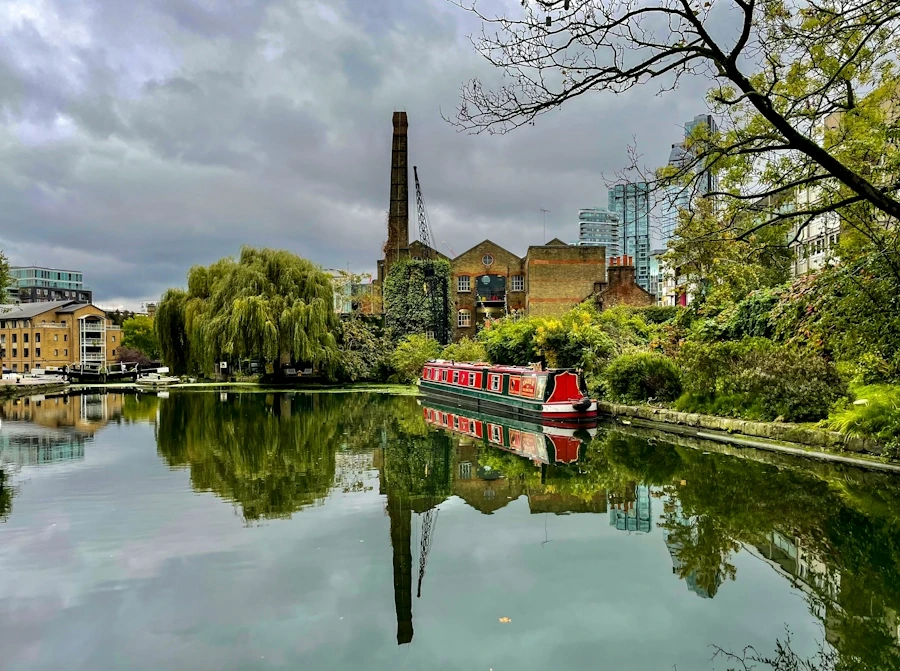
Make this your London itinerary
THE SHORT VERSION
- Check towpath connections and accept necessary street diversions.
- Treat moored boats as homes and workplaces as well as part of the view.
- Choose Camden or Regent’s Park as a substantial finish rather than adding both automatically.
Follow the water, but keep your own pace
Regent's Canal offers a useful escape from the feeling that London must always be crossed by underground train. Around Little Venice, the park edge, and Camden, water gives the day a different organizing line. The Canal & River Trust describes a route through these places, but a continuous line on a map does not guarantee an uninterrupted waterside walk. Use current towpath information and pedestrian directions, especially around tunnels and temporary closures. The outing works best when small street diversions are accepted as part of it.
I would make this a walking day with a clear endpoint rather than promise to follow the canal across all of London. Start near Little Venice and aim toward Camden if that distance fits your group, or choose one shorter section and a meal. The aim is to notice the city changing around a working waterway. A shorter route with several pauses is often more interesting than a long one completed mainly to say you reached the end.
Begin by understanding Little Venice
Little Venice is a useful place to establish the relationship among water, boats, paths, and nearby buildings. The Trust identifies it as the meeting area of the Grand Union and Regent's canals. Take a circuit where public access allows and look at how the junction changes the shape of the space. Boats here are not simply decorative objects; some are homes or workplaces, and the canal remains infrastructure as well as a leisure route.
A café stop can make a pleasant beginning if you arrive early enough to enjoy it without watching the clock. Choose a view and a drink you want, then confirm the next walking connection. Do not step onto boats or lean over residential windows for photographs. The waterway's intimate scale is part of its charm, but it also makes the boundary between public path and private life especially important. Respecting that boundary keeps the walk comfortable for everyone.
At Little Venice, compare the wider meeting of waterways with the narrower canal you intend to follow. That change of proportion makes a good visual opening. The later appearance of bridges and enclosed banks will then feel like a series of changing spaces rather than an unvarying walk beside water.
Let diversions reveal the neighborhood
Some sections require you to leave the water and use surrounding streets. Plan those connections with a current map rather than improvise at a closed gate or assume a tunnel has a pedestrian path. The change is not necessarily a disappointment. A street-level interval shows how the canal sits below and beside everyday London, while the return to water can feel more distinctive after a few ordinary blocks. You are exploring the relationship between two urban systems.
Keep navigation pauses away from narrow paths and entrances. With a group, agree on the next meeting point before anyone walks ahead. That small habit is more useful than trying to maintain a perfect formation on a towpath used by walkers, runners, cyclists, and others. Let faster users pass where practical and stay aware of the water's edge. This is a shared corridor, so a considerate pace is a better plan than treating it as a private promenade.
The park edge changes the setting
Near Regent's Park, the canal's surroundings provide a contrast with the more enclosed beginnings of the walk. Notice how vegetation, buildings, and changing views alter the sense of distance. You do not need to identify every structure along the bank; choose a few details and see how they relate to the water. Bridges are particularly useful because they frame the canal and reveal its level within the city. One patient stop can explain more than several hurried photographs.
Regent's Park itself is an optional separate chapter. Consult the Royal Parks information and choose an entrance and internal route that fit your day. A detour into the park should replace part of the canal ambition rather than simply extend everything. You might prefer planting and a bench to another stretch of towpath. That is a good reason to change the plan, not evidence that the original route was badly chosen.
Camden supplies a different energy
The approach to Camden brings the canal into a busier setting. The Trust connects the waterway here with the market area, and Camden Market's own information can help you choose what interests you. Treat the market as a possible finish rather than an obligation to shop every passage. After the walk, you may want food and a seat more than another hour of browsing. Decide before entering the busiest sections so the group has a shared expectation.
If you do browse, pick a category or a small area. Clothing, objects, and food can quickly become an undifferentiated stream when you are already tired. Look carefully at the things you might actually buy, compare prices and quality, and leave room to decline. A souvenir should suit your life after the trip. The canal walk itself may already be the experience you wanted, in which case a simple meal is a perfectly good ending.
Food should be easy to carry only if you must
Takeaway can seem convenient until you are balancing a hot meal beside a narrow waterway. Before ordering, identify where you can sit appropriately and whether the food suits the setting. A restaurant or café may be the more relaxing choice after several hours outside. My preference would be to stop for a real break at Camden rather than keep eating and walking. You can appreciate the canal without making every part of the day happen at its edge.
Carry enough water and a small snack if that helps the walking interval, but avoid loading the bag with everything you might possibly need. The route has urban exits and transport options; it is not a remote expedition. What matters most is knowing where you can leave the walk if someone is tired. Choose that fallback before starting, especially when traveling with children or anyone whose comfortable walking distance is still uncertain.
End while the walk still feels good
Check the nearest useful transport from your actual endpoint rather than assume the canal will deliver you directly to a station entrance. If the weather turns or a section is closed, shorten the route and enjoy the part you have already seen. The attraction is the change in rhythm from busy streets, not the achievement of a particular distance. A good walk leaves enough energy for the evening without making the rest of the trip feel like recovery.
For a shorter version, enjoy Little Venice and a nearby pause. For a park-focused version, replace the market with time in Regent's Park. For the full outing, walk toward Camden with street connections accepted and lunch waiting at the end. London becomes easier to understand when you follow one of its quieter lines. The canal will still continue beyond your chosen finish, which is a useful reminder that a city does not need to be completed to be enjoyed.
Sources & further reading
First published 18 October 2026. Page updated 19 October 2026. Planning references checked on 18 October 2026. The edition date above follows your device’s time zone; it does not indicate a new research check. Confirm current opening details and booking arrangements with the places you plan to visit.