
Make this your Marrakech itinerary
THE SHORT VERSION
- Use Jemaa el-Fna and one cultural site as reliable route anchors.
- Browse one category of craft thoughtfully instead of buying impulsively.
- Take a proper break before deciding how much more of the medina to explore.
Begin with a place you can find again
Marrakech's medina does not need to be conquered in one wandering afternoon. I would start with a clear public meeting point, a cultural stop such as Ben Youssef Medersa, and a café where the day can slow down. The streets in between supply plenty of interest. A loose plan gives you freedom to look without turning every uncertain junction into part of a romantic story about getting lost. You are more likely to notice the place when you are not preoccupied with finding a way out.
UNESCO describes the medina as a living historic town, with lanes, homes, souks, and artisanal activity contributing to its value. That is a useful starting idea: the attraction is not simply a collection of monuments inside walls. It is the relationship among buildings, work, commerce, and movement. Choose a modest section and allow it to become legible. A few connected observations will tell you more than a long route followed at speed.
Jemaa el-Fna is an orientation point
Jemaa el-Fna can provide a clear beginning or ending, but the experience changes with the activity around you. Pause at an appropriate edge and look at how routes enter and leave the square. A large open space can be helpful after smaller streets, and its relationship with the medina matters as much as any individual performance or stall. Do not expect one visit to explain everything happening there. Let the square orient you before choosing the next direction.
If you want a drink overlooking the area, read the actual menu and confirm the seating arrangement before ordering. Paying for a view can be a conscious and enjoyable choice; it is less pleasant when you have not understood what the venue offers. Keep photographs considerate, especially when people or performances are the subject, and ask about arrangements rather than assume every interaction is free. A little clarity leaves more room to enjoy what is in front of you.
Choose a cultural anchor inside the lanes
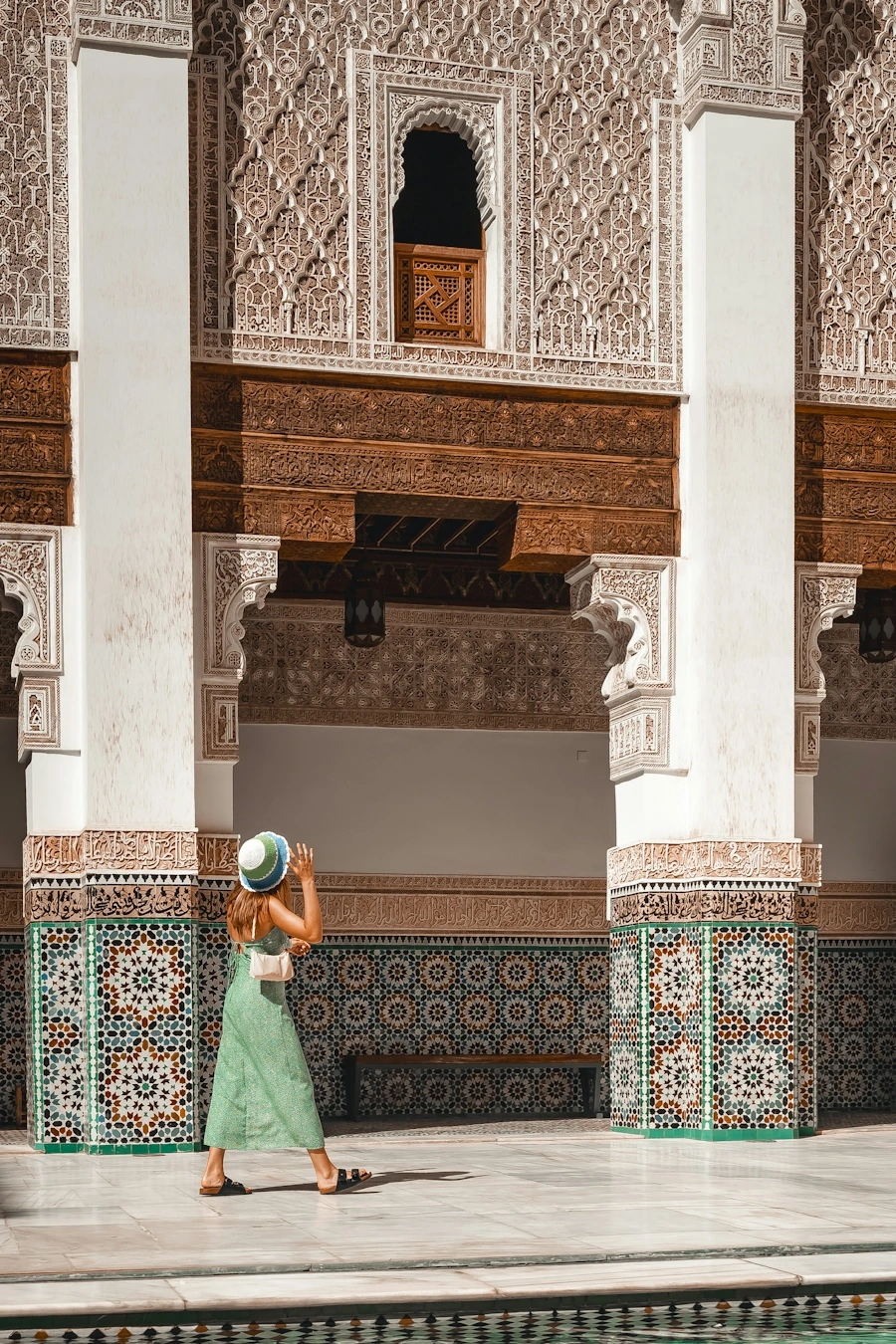
Ben Youssef Medersa gives a northern-medina walk a specific destination and an indoor architectural subject. Its official site provides current visit information and describes the building's educational history. Check access before setting out and use a current route to reach it. The visit can then become the fixed center of a flexible outing: streets before, a considered interior, and a pause afterward. That is a stronger shape than browsing until fatigue determines the endpoint.
Inside, begin with the whole courtyard before examining ornament. Notice the relation of water, open sky, doorways, and upper levels. Then look closely at a small section of pattern or material. The contrast between large arrangement and fine detail is part of the pleasure. You do not need to photograph every surface. A few careful views and a clear understanding of the building's purpose can make the visit more memorable than a sequence of decorative close-ups.
The medersa's student rooms offer a useful contrast with the main courtyard. Where the current route allows, notice how scale changes between communal space and more confined accommodation. That comparison can make the educational purpose feel more tangible than another decorative photograph and gives the visit a reason beyond its visual richness.
Browse the souks with a real interest
Choose a category of goods that genuinely appeals to you: ceramics, textiles, metalwork, or something else you might use. Look at materials, finish, size, and how an object is made. A focused interest makes browsing more enjoyable because you can compare thoughtfully instead of responding to every invitation. Buying is optional. You can appreciate skill and ask a practical question without needing to bring home a large collection of things chosen mainly because the market felt persuasive.
If you want to buy, clarify the item and total price before agreeing. Take time to decide whether it fits your budget and your luggage. Negotiation, where appropriate, should remain polite and leave room to decline. Do not begin an elaborate exchange merely as entertainment if you have no intention of purchasing. A good interaction is one in which both sides understand what is being discussed, rather than one measured only by how dramatic a discount you can describe afterward.
Watch the working street, not only the display
The medina's routes accommodate many ordinary tasks alongside sightseeing. Stop in places that leave space for people moving goods, shopping, or reaching home. Notice how a street changes when a workshop opens to it or a covered section alters the light. These details can make the visit feel more specific than another list of must-see objects. The old city is interesting because different uses coexist, sometimes comfortably and sometimes with the friction of a busy shared space.
Use a guide if you want deeper interpretation or a more confident introduction to the route. Choose someone through a reputable, properly identified service and agree on the scope and cost in advance. A guided walk can be especially valuable when your interest is craft or architecture rather than shopping alone. It is also reasonable to explore a smaller section independently. The right choice is the one that gives you enough confidence to remain curious and attentive.
Put a genuine break in the middle
A café or lunch stop should happen before everyone is exhausted. Choose according to the food, seating, and atmosphere you want, and ask about unfamiliar dishes. A simple meal can be better than an elaborate spread if the afternoon still includes walking. Mint tea can provide a long pause, but it need not become a compulsory ritual at every stop. Give one place time and let the rest of the route remain open to what feels appealing afterward.
This is a useful moment to check your orientation and decide whether the outing should continue. You may want another cultural site, a shorter shopping circuit, or a return to your accommodation. I would not treat shortening the route as a failure. The medina asks for sustained attention, and a clear first visit can make later exploration easier. Rest is part of building that understanding, not time taken away from it.
Leave with a few anchors of your own
Use current directions to return to the point you chose or another transport arrangement you understand. Notice what has become familiar: a corner, a gate, a public square, or the relation between a cultural site and the surrounding streets. Those modest anchors are a useful result. You have begun to read part of the medina rather than simply move through it. Save another section for a different day, when familiarity can support a little more freedom.
For a first version, the square, one interior, some focused browsing, and a proper break are enough. Keep the scale humane and the curiosity specific. Marrakech's old city offers far more than one visit can absorb, but it does not demand that you experience all of it at once. A route you can remember, a place you would revisit, and an object or detail you understand better make a complete and worthwhile afternoon.
Sources & further reading
First published 18 October 2026. Page updated 19 October 2026. Planning references checked on 18 October 2026. The edition date above follows your device’s time zone; it does not indicate a new research check. Confirm current opening details and booking arrangements with the places you plan to visit.