
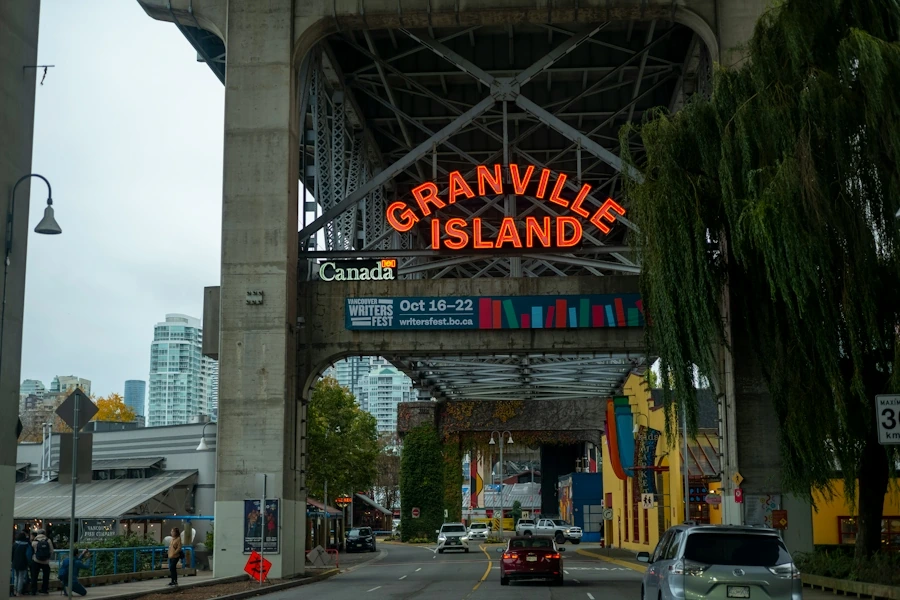
Make this your Vancouver itinerary
THE SHORT VERSION
- Browse Granville Island once before choosing a modest lunch and a seating plan.
- Make time for a studio or creative business beyond the Public Market.
- Treat the waterfront route to Kitsilano as a substantial optional walk and check the return transport.
Start with an appetite and a small plan
Granville Island is a good place to begin a day without scheduling every hour. The market gives you an immediate reason to arrive, while studios, waterfront paths, and the surrounding neighborhood provide more than enough material afterward. I’d pair it with a measured walk toward Kitsilano, keeping the beach as an optional finish rather than a deadline. This is a day for food, making, and water views, not an attempt to cover Vancouver’s entire south shore.
Arrive by the transport that suits your starting point. A small False Creek ferry can make the approach enjoyable when its current route and boarding arrangements work for you; a bus or a straightforward walk may be simpler. Check before setting off rather than assuming every waterfront landing serves the same destination. Save your first substantial food stop for the market, but do not arrive so hungry that the first queue decides your whole meal.
Browse the market before committing to lunch
The Public Market mixes ingredients, prepared food, and the bustle of a destination that attracts visitors as well as local shoppers. Take one initial circuit to understand the choices. Look at produce, bread, fish counters, and food stalls rather than narrowing the visit immediately to the most photographed snack. What is in season can be a better guide to a satisfying purchase than a list of supposedly essential bites.
I’d build a modest lunch from one main item and a small extra, then add more only if still hungry. Check portion sizes and ingredients, and have payment ready when you reach a busy counter. If traveling with friends who order separately, agree on a meeting point before everyone disappears into different lines. Seating can affect the meal as much as food choice, so decide whether you want to eat inside, use an appropriate outdoor area, or take something for later.
Keep an eye on the food outdoors
A waterfront lunch is appealing, but it deserves a little attention to practical details. Birds can be assertive around unattended food, and wind can turn lightweight packaging into litter quickly. Keep the meal close, secure napkins, and use proper bins. I’d avoid buying an elaborate spread if there is nowhere comfortable to sit. A simple sandwich, fruit, or pastry can be the better outdoor meal when you are balancing a bag and a drink.
Do not treat a busy market table as a personal base for the entire afternoon while others look for space. Once finished, make room and continue exploring. If you want a long sit-down lunch, choose a restaurant that offers that experience and compare the menu first. The market is enjoyable partly because it keeps moving. You can participate in that rhythm without rushing, provided you leave the long pause for somewhere designed to accommodate it.
Look beyond the counters
Granville Island’s studios, shops, and performance spaces are worth attention after lunch. The former industrial setting gives the area a different texture from Vancouver’s glass towers, and the creative businesses make it more than a food hall. Look for work that interests you and ask about public studio access before entering. Watching a maker at work can be engaging, but only when visitors are welcome and the activity is not interrupted for a photograph.
I’d choose one material or form to investigate: ceramics, print, textiles, glass, or another practice you genuinely enjoy. Ask about the process and the maker behind a piece rather than searching only for the cheapest souvenir. A smaller well-made object can carry a clearer memory than several generic purchases. Check performance schedules separately if you want an evening event. That may become the day’s anchor, in which case a long onward walk is optional rather than necessary.
Follow False Creek at a comfortable pace
When you are ready to leave the island area, the waterfront offers a way to connect food and art with a broader sense of the city. Choose a public walking route toward Vanier Park and Kitsilano, checking the map for current crossings and works. The distance is a real walk, not a few steps between adjacent attractions, so pause before committing if anyone is already tired. Transit can bridge part of the day without diminishing it.
The views across False Creek change as you move, giving familiar towers a different foreground of boats, paths, and green space. Keep clear of cycle routes and pause where people can pass. I’d take a few photographs from places that feel comfortable rather than stopping at every opening in the view. The pleasure is the connection between neighborhoods, and that is easier to appreciate when you leave some of the walk uninterrupted by the camera.
Let Kitsilano be a neighborhood too
Kitsilano Beach is an appealing final destination, but the surrounding streets give it context. If you have energy, browse part of the neighborhood for coffee, a shop, or dinner, instead of treating the sand as an endpoint detached from daily life. The area can feel busy and relaxed at once, which is part of its appeal. A beach seat, a short promenade, and a drink can be enough after a substantial market visit.
Swimming or pool plans need separate checks for current opening, bookings, and conditions. I’d avoid promising them as a guaranteed reward at the end of a long walk. A cloudy or cool day can still suit the coast, especially with a layer and a warm drink. If sunset is attractive, stay only if the return remains easy. There is no need to wait several hours at the beach just because it appears in every imagined Vancouver evening.
Choose the version your group will enjoy
For a short day, stay around Granville Island: market lunch, one studio, and a waterfront pause make a complete outing. For a longer version, continue toward Kitsilano and finish with a neighborhood meal. If rain arrives, keep the market and cultural spaces, then use transit for the connection. Families might prefer a shorter walk and more unstructured play, while food-focused travelers may want a second careful browse of the market instead of another kilometer by the water.
Before leaving the beach or restaurant, identify the current transit connection back to your accommodation. Do not assume the ferry you used in the morning will be the right return from a different neighborhood. I’d remember this day through its changes in scale: a small ingredient on a market counter, a piece in a studio, a wide view across the creek. You do not need many more stops than that to feel you have spent the day well.
Sources & further reading
First published 18 October 2026. Page updated 19 October 2026. Planning references checked on 18 October 2026. The edition date above follows your device’s time zone; it does not indicate a new research check. Confirm current opening details and booking arrangements with the places you plan to visit.