
Make this your Vancouver itinerary
THE SHORT VERSION
- Combine an open waterfront section with a suitable interior trail rather than insisting on the full loop.
- Recheck the announced October–November 2026 seawall works and follow signed detours.
- Read cultural interpretation and plan food and an exit before the long walk begins.
You do not need to complete the loop
Stanley Park inspires a familiar travel impulse: find the famous seawall, follow it all the way around, and count the loop as done. I’d begin differently. Choose a waterfront section and a forest section, then leave time to sit. That gives you a better sense of the park’s variety and avoids making a scenic day depend on completing a distance that may not suit the weather or everyone’s energy.
Check current city notices before choosing a route. As checked on October 18, 2026, Vancouver has announced a seawall closure between Lumberman’s Arch and Third Beach from October 19 to November 7, with intermittent closures possible until November 20. Follow the posted detours and recheck for changes. This is exactly why a flexible plan works: the park still offers substantial interest when one waterfront segment is unavailable. A saved image of the standard loop is not a current access map.
Enter from the side that fits your day
Coal Harbour and the West End offer different approaches, so start where you can arrive easily instead of crossing town for a prescribed entrance. The Coal Harbour side introduces water, boats, and the park’s relationship with downtown. An approach from English Bay emphasizes beach and residential streets before the trees. Both can work, and you can choose an exit near lunch or your onward transit rather than returning automatically to the same point.
I’d collect a current map and identify toilets, a rest stop, and an achievable turnaround. Distances inside a large park can be deceptive when the route curves around water or follows a trail through trees. Families and travelers with limited stamina benefit from deciding on a shorter version before leaving the entrance area. A good plan has a point where you can comfortably say that you have seen enough, without needing to cross the entire park to get out.
Use the seawall as shared public space
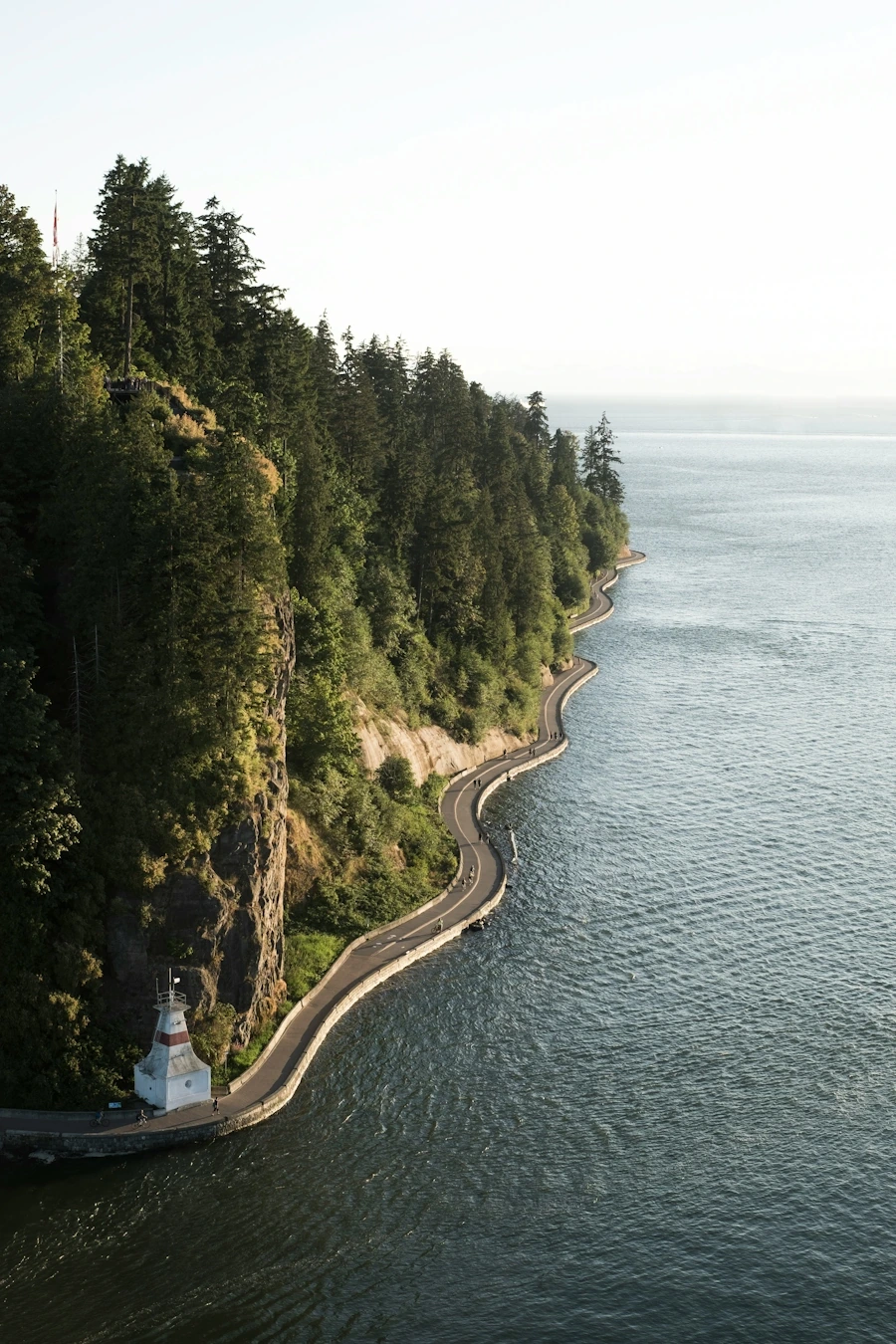
On an open section of seawall, enjoy the changing relationship between skyline, water, mountains, and trees. The path is especially rewarding when you stop trying to frame every view perfectly. Look at how the city meets the park, then at how quickly the vegetation changes the feeling of the route. Keep to the correct walking or cycling area and follow posted directions. A relaxed pace depends on everyone understanding that this is a busy shared system.
If renting a bike, choose it because you want to cycle, not because you feel the loop must be completed quickly. Check the permitted direction and current detours before setting off. Stopping suddenly in a narrow cycle lane is inconvenient and unsafe, so pull into an appropriate place for photographs. I’d walk on a first visit if time allows, since it makes the small pauses easier. Either approach can be enjoyable when you do not mix incompatible expectations.
Use the Coal Harbour skyline as an opening view, then let the trees gradually replace towers as the route’s main landmark.
Let the forest change your scale
An interior trail offers a useful contrast to the open water. Under trees, the interest shifts toward texture, shade, fallen wood, and the way sound changes. Choose a signed public route suitable for current conditions, and stay on it. The city’s official map helps connect the forest with the entrances and facilities you actually need. Do not assume a line disappearing into vegetation is a convenient shortcut back to the beach.
I’d leave some time without headphones here. It becomes easier to hear other trail users, birds, wind, and the changing surface underfoot. The forest is not separate from management: storms, tree health, maintenance, and conservation all influence the paths. Respect closures even when the area beyond a barrier looks inviting. If you want to understand more, read the city’s material about the park’s history and ongoing care rather than describing every wooded space as untouched wilderness.
Notice cultural history as well as scenery
Stanley Park is not an empty natural stage next to a modern city. The land has long-standing Indigenous connections, and the official city map acknowledges the Musqueam, Squamish, and Tsleil-Waututh Nations. Give cultural interpretation time when you encounter it, and avoid treating carved poles or other cultural features merely as decorative objects. Read the information provided and distinguish the histories represented rather than combining them into one vague story.
A guided visit led by an appropriate knowledgeable provider can add context if this is an important interest for you. Check who is telling the story and what the tour covers. I’d rather learn a little accurately than repeat an attractive anecdote without knowing its source. The same applies to place names and historic photographs. They are useful invitations to look more closely at how the park became the place visitors see today, not just facts to collect before moving on.
Plan a beach pause without promising sunshine
Second Beach, Third Beach, and the English Bay side can offer appealing pauses when access and conditions suit your route. A beach stop does not require a swim. Bring a layer, sit somewhere appropriate, and enjoy the wider horizon after time among trees. Vancouver weather can turn a bright plan into a damp one quickly, so keep belongings protected and know which nearby indoor option would make a comfortable alternative.
I’d treat food as part of the route planning rather than hope that the ideal café appears just as everyone gets hungry. Bring a simple snack or identify a place near your exit. Do not feed wildlife, and keep food secure. If you want a picnic, choose a suitable area and carry rubbish out. A well-timed break can be the difference between a satisfying long walk and the final hour becoming a negotiation about how much farther there is to go.
Finish with a neighborhood, not another marathon
After the park, the West End or Coal Harbour can provide lunch, coffee, or an easy transition back into the city. Choose the area nearest your exit and resist adding another distant attraction just because the park visit ended early. A shorter route may have given you more attention, not less value. Check current transit before heading away from the entrance, especially if rain or tired legs have changed your willingness to walk.
For a first visit, I’d keep the day simple: one open waterfront stretch, one suitable forest trail, a cultural stop, and a proper pause. Adapt that sequence around closures and your group’s needs. Stanley Park is memorable because water, forest, history, and daily recreation meet here. You will notice that meeting more clearly when the route leaves enough room to look, rather than asking the whole day to prove you finished a loop.
Sources & further reading
First published 18 October 2026. Page updated 19 October 2026. Planning references checked on 18 October 2026. The edition date above follows your device’s time zone; it does not indicate a new research check. Confirm current opening details and booking arrangements with the places you plan to visit.