
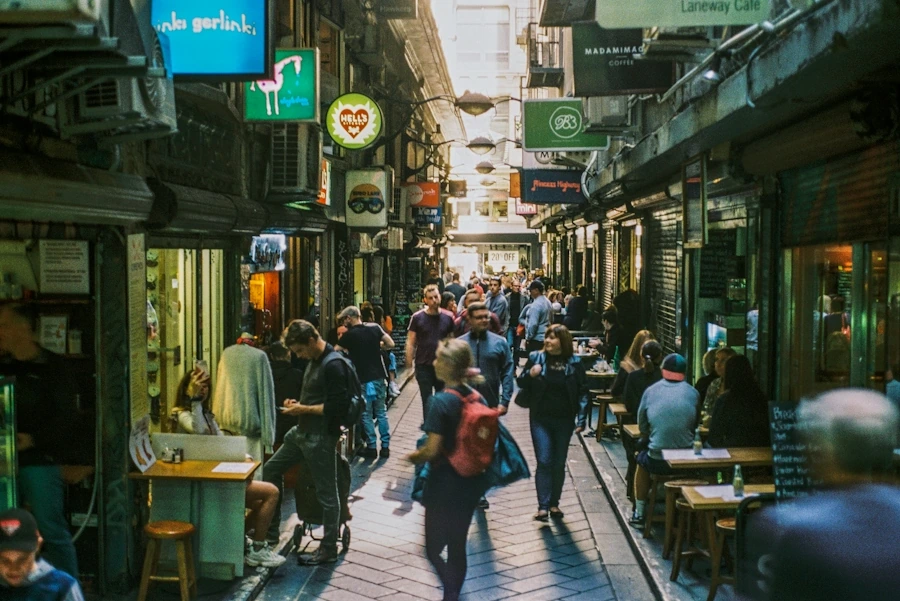
Make this your Melbourne itinerary
THE SHORT VERSION
- Choose a compact laneway-and-arcade area.
- Expect street art to change instead of chasing an old image.
- Use one seated coffee break to slow the route.
Pick a small patch of the city grid
Melbourne’s laneways can become an unexpectedly busy checklist. A visitor arrives with saved names, crosses the city grid repeatedly, and discovers that the pleasure of turning a corner has disappeared. I would choose a compact area around Flinders Lane and the central arcades, then follow a handful of connections properly. The point is to see how a large city creates small spaces, not to prove you have entered every named passage.
Begin by looking at the wider street before stepping into a lane. The shift in scale is part of the experience: traffic noise drops or changes, walls come closer, and a small cafe or doorway becomes more noticeable. Look up at signage and upper windows as well as at the ground-level businesses. A lane is an urban space, not just a backdrop behind a cup of coffee.
Look at street art as something changing
Hosier Lane is a familiar starting point for street art, but the work you see may not match a photograph saved weeks or years earlier. That is part of the visit. Layers change, surfaces are repainted, and one person’s highlight can disappear beneath another work. Instead of searching for an exact image, look at scale, technique, color, and how different pieces compete for attention.
Keep the lane functioning while you look. Do not block a working doorway, stand in the path of deliveries, or assume that every surface is available for visitors to mark. Photograph respectfully when artists are present and ask before making a close portrait or recording their process. The fact that work is outdoors does not remove ordinary courtesy toward the person making it.
Use an arcade for a different kind of detail
A covered arcade offers another version of concentrated city space. The Royal Arcade or Block Arcade can shift your attention from painted surfaces to shopfronts, flooring, ceilings, and the rhythm of a passage. Walk through once before stopping, then find a suitable place to look more closely. These are commercial spaces with their own rules and pedestrian flow, so keep entrances clear.
Browsing does not need to become a purchase at every stop. Choose a shop that interests you and look at its selection rather than feeling obliged to collect a souvenir. If you buy something fragile or bulky, remember that you will carry it for the rest of the day. One thoughtful object is enough to give the visit a personal connection.
Make coffee a pause, not a performance
Coffee is a pleasant part of a Melbourne day, but you do not need to choose the most complicated order or the most famous queue. Find somewhere whose seating and menu suit you, order what you enjoy, and take enough time to rest. A good cafe stop should make the next walk more enjoyable rather than add another item to document.
For the final section, choose a gallery, a bookshop, or simply another public-street loop according to your remaining attention. Flinders Lane can provide several possibilities, but verify current hours for any particular venue. End where you want to linger over lunch or a drink. You will remember Melbourne’s smaller spaces more clearly if the afternoon has included time to inhabit them, rather than only time to pass through.
Choose a turn, then look at what changed
A laneway route is most satisfying when you can see how one street connects to another. Pick a small central area near Flinders Lane, then add an arcade and one street-art stop. Check public access instead of assuming every narrow opening is a through-route. Some passages serve businesses or close under particular arrangements. If a lane does not lead where expected, return to the wider street rather than entering a private courtyard. The pleasure is in noticing urban connections, not in forcing an exploration story into every doorway.
Hosier Lane is a useful place to approach street art as something temporary. Compare layers, textures, and scale; read an artist credit when one is visible. A work missing from an old saved photograph is not evidence that the visit has failed. The surface has continued to change. If someone is painting, do not assume their presence creates a public demonstration. Ask before recording closely, keep equipment out of the route, and give working space priority. A brief observation from farther away can be enough, particularly when the lane is already busy with deliveries and visitors.
The Block Arcade or Royal Arcade offers a different visual conversation. Floors, ceilings, storefront proportions, and the way light enters can be as interesting as merchandise. Walk through once without stopping at the first attractive window, then return to a detail that caught your attention. Respect the fact that these are commercial interiors. Ask about photography where needed, avoid obstructing shop entrances, and let customers move through. You do not need to buy something to notice the design, but if a shop’s goods appeal, give them proper consideration rather than using the interior only as scenery.
Coffee works best as the moment the route stops being a route. Choose a seat you want to use and a drink you enjoy. Ask about a menu term if it is unfamiliar instead of ordering something complicated because it appears more suitably Melbourne. If lunch is still ahead, be realistic about whether a pastry will leave you hungry again immediately. A proper meal in the same small area can keep the afternoon coherent. Crossing the city for another famous cafe might be enjoyable another day, but it is not required to establish that you appreciate local coffee culture.
For the last stretch, follow a real interest. A gallery exhibition, bookshop, or small design store can give you another subject after walls and arcades. Check the specific venue’s current opening information and choose one rather than trying to add all three. If rain arrives, the covered arcade and a longer meal can become the complete afternoon. If the sky clears, a final public-street loop is enough. Leave with a few distinctions in mind: the lane whose scale surprised you, the painted surface that held your attention, and the place where you were happy to sit.
Read a lane in both directions
Before leaving a lane you liked, turn around and look back from a safe position. A sign, doorway, or patch of upper-floor light may become more noticeable in the reverse view. This small habit can make a compact route feel richer without adding distance. Apply it to an arcade too, where a ceiling or line of storefronts may read differently from each end. Take care not to step into approaching pedestrians while looking upward. Melbourne’s narrow spaces reward this kind of repeated observation: the same short passage can offer more than one composition if you slow down enough to see it.
Sources & further reading
First published 18 October 2026. Page updated 19 October 2026. Planning references checked on 18 October 2026. The edition date above follows your device’s time zone; it does not indicate a new research check. Confirm current opening details and booking arrangements with the places you plan to visit.