
Make this your Singapore itinerary
THE SHORT VERSION
- Explore each neighborhood on foot but use transit between them.
- Read religious-site entry and photography notices.
- Give heritage businesses as much attention as murals and boutiques.
Do not make heritage a single photograph
Chinatown and Kampong Gelam are often reduced to the same shorthand: colorful shophouses, a religious landmark, and somewhere good to eat. They are more interesting when you give their differences room. I would spend a morning in one and a later afternoon in the other, using the MRT between them. Trying to turn the connection into a long hot walk can consume the energy you wanted for the neighborhoods themselves.
Begin in Chinatown with street names and building details rather than a shopping list. Telok Ayer and the streets around the main Chinatown area reveal different arrangements of shrines, temples, commercial buildings, and places to eat. The juxtaposition matters. Singapore’s histories of migration and trade are visible in close proximity, but no single facade can explain them. Pick one institution to enter, read its interpretation, and let that information sharpen the next part of your walk.
Give worship its own space
Sri Mariamman Temple and the Buddha Tooth Relic Temple are notable Chinatown landmarks, but both need to be approached as places of religious practice. Read entrance notices, follow dress and photography requirements, and avoid treating worshippers as part of the decor. If a ceremony or access restriction changes your route, simply continue elsewhere. A respectful visit does not depend on getting inside every building.
Between the landmarks, allow a stop for a drink or snack without assuming the busiest queue must be your best option. Look at what the stall or cafe actually serves and whether it suits your appetite. You will learn more from a meal you can enjoy comfortably than from standing in the heat for something you only recognize from a video.
Take the transit break seriously
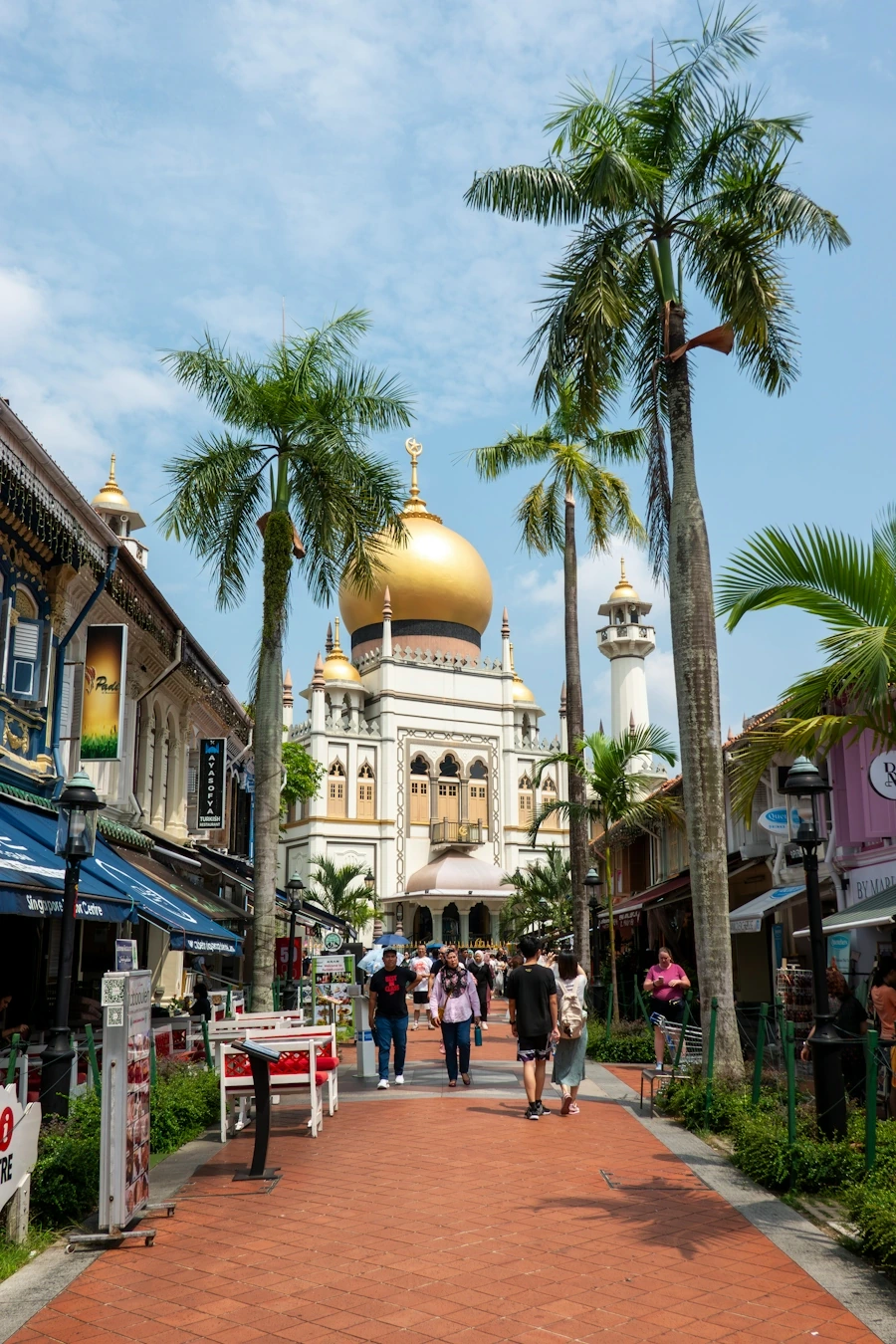
The transfer to Kampong Gelam is a useful pause rather than wasted time. Check the station exit before emerging, find water, and decide which part of the district you want first. Sultan Mosque and the surrounding streets give you a clear starting orientation. The mosque’s dome is visible from several approaches, so there is no need to occupy the center of a busy passage to obtain a symmetrical picture.
Around Arab Street and nearby lanes, look for the relationship between textile shops, food businesses, contemporary retail, and religious life. It is easy to focus only on the murals and boutiques because they photograph readily. Take time to read a business sign, notice what is being sold, or ask a shopkeeper a concise question when they are not busy. The neighborhood becomes richer when it is more than a sequence of backdrops.
Leave room for a meal and a second look
Haji Lane is a lively addition, though it is only one part of Kampong Gelam. Browse it at your own pace, step out of the stream of pedestrians before stopping, and look beyond the first block that catches your attention. If street art interests you, walk around a corner and consider how a mural works with the shape of the building. Ask permission before making a shop interior or a person the subject of your photograph.
For dinner, choose a dish and a setting rather than trying to sample the whole district. Malay and other regional food traditions deserve attention beyond a generic label of local cuisine. Read the menu, ask what is included, and be clear about dietary needs. Ending with a proper meal gives both neighborhoods a place in your memory: one has not simply blurred into the next during a long afternoon of hot pavements.
Two neighborhoods, with a useful pause between
The practical success of this pairing depends on giving Chinatown and Kampong Gelam separate chapters. Start near the Chinatown cluster you most want to understand, then transfer toward Bugis for the later walk. Check the station exit at both ends, because a seemingly small error can put you on the wrong side of a major road. If you are already tired after Chinatown, stop there. You will learn more from returning to Kampong Gelam with fresh attention than from adding it as a hurried obligation in the hottest part of the day.
In Chinatown, choose between a heritage-focused route around religious and community institutions and a meal-centered route near a hawker center. They can overlap, but one should lead. A visitor who wants to read interpretation may enjoy a longer indoor stop, while a food-focused traveler may prefer more browsing before lunch. The nearby buildings should not become anonymous scenery around whichever interest wins. Look at the address and street name, note how one institution relates to the next, and consider how much diversity fits within a short walk.
Kampong Gelam deserves its own vocabulary. Arab Street, Haji Lane, the mosque approach, and the surrounding businesses are not interchangeable versions of a colorful shopping district. Textiles, religious life, murals, food, and newer retail occupy the neighborhood together. Pick a question to guide your browsing: perhaps how a material is used, what a dish contains, or how a mural fits a particular wall. That creates an encounter you can remember without asking a shopkeeper to explain the entire district. If the shop is busy, buy or browse quietly and leave the longer question for another time.
At religious entrances, read the instructions even if you visited another temple or mosque earlier that morning. Footwear, dress, prayer-time access, and photography rules belong to the specific institution. Do not infer permission from an open door or from another visitor’s behavior. A view from the public street can be enough when access is limited. Around Sultan Mosque, keep movement through the approach clear and avoid arranging a group picture where people are entering for worship. The architectural view is appealing precisely because it belongs to an active place.
Make the final meal a decision about food rather than location alone. Read several menus, choose something the group wants, and ask direct questions about ingredients. A neighborhood associated with several culinary traditions rewards more specificity than a generic request for local food. After dinner, a short public-street loop can show a different evening mood, but it is not necessary to repeat every lane you saw in daylight. Leave from a convenient transit point with a clear memory of two districts whose differences you gave yourself time to notice.
A small detail to follow
Shophouse facades offer a useful visual thread between the two districts, provided you resist treating them as identical. Look at window shapes, signage, the sheltered walkway, and the relationship between a ground-floor business and the building above. You can follow those details without making claims about a structure’s age that you have not checked. In Kampong Gelam, a textile shop may suggest one question about use and material; in Chinatown, a food or household business may suggest another. Let the goods make each encounter particular. Two photographs of colorful buildings then become the beginning of a comparison rather than the whole story.
Sources & further reading
First published 18 October 2026. Page updated 19 October 2026. Planning references checked on 18 October 2026. The edition date above follows your device’s time zone; it does not indicate a new research check. Confirm current opening details and booking arrangements with the places you plan to visit.