
Make this your Paris itinerary
THE SHORT VERSION
- Pair the summit with Musée de Montmartre rather than only a panorama stop.
- Check hill access and museum information separately.
- Use a downhill route to notice the neighborhood after the busiest hilltop spaces.
The view is a beginning, not a finish
Montmartre can become a very short story: climb, photograph the skyline, buy something, leave. I would give the hill a little more narrative. Start with the view, then choose the Musée de Montmartre as a way into the neighborhood's artistic history, and finish with a slow descent through public streets. That sequence lets the famous panorama do its job without requiring it to carry the whole afternoon. The smaller spaces afterward will feel more distinct because you have first seen the city at a distance.
Decide how you want to handle the elevation before planning individual stops. A hill is part of the charm when you have comfortable shoes and enough energy; it can dominate the day when you do not. Use the current transport map to choose an arrival and check any lift, funicular, or access arrangements you intend to rely on. There is no virtue in reaching the summit exhausted if the museum and neighborhood are what really interest you.
Arrive with your attention available
The streets around the upper hill can be lively, so keep the beginning uncomplicated. Find your bearings, identify the basilica, and take a moment to look outward before photographing. Try reading the skyline as a city rather than a collection of recognizable buildings: density, roofs, distant towers, and the difference between nearby detail and faraway scale. A view becomes personal when you decide what you are looking for instead of reproducing an image you have already seen.
Sacré-Cœur is an active religious place as well as a landmark. If entering, consult its own guidance and allow the interior to be a different kind of experience from the public space outside. A quiet visit should not be rushed because your next stop appears only a short distance away. If you prefer to remain outside, appreciate the building from several angles and move on without treating entry as compulsory. The day has more than one meaningful center.
Give the museum the middle of the day
The Musée de Montmartre is the stop I would protect from an overambitious schedule. Its own description connects the old buildings with artists including Renoir and Suzanne Valadon, while the museum offers collection rooms, a workshop, and gardens. That combination helps ground the familiar idea of artistic Montmartre in a place with rooms and working histories. It is more satisfying than relying entirely on souvenir imagery to explain why the neighborhood became associated with art.
Check the exhibition program and visitor route for your date. You might be most interested in Valadon's studio setting, the broader neighborhood story, or an exhibition that gives the visit a sharper theme. Choose accordingly and let one or two works hold your attention. An artist's biography can be complicated; the goal of a first visit is to find an entry point, not memorize every name connected with the hill before you have had lunch.
Suzanne Valadon's workshop gives this visit a particularly good focal point. A working space can make artistic life easier to imagine than a list of famous residents, because the room asks practical questions about light, position, and making. Follow the museum's interpretation and compare that interior scale with the broad panorama outside.
Let the gardens slow the rhythm
The museum's Renoir gardens give the indoor visit an outdoor continuation. Paris tourism information notes their outlook toward the Clos Montmartre vineyard. Look at that relationship between cultivation, garden, and dense city rather than assuming the vineyard is an open public attraction. The pleasure is in seeing a different texture of Paris within the hilltop setting. It is an especially good moment to stop adding information and simply take in the arrangement of the place.
I would leave enough time here to revisit a thought from the galleries or sketch a detail in a notebook. Gardens inside a cultural visit can feel like an interval you are meant to hurry through, but they often change how the whole institution is remembered. If the weather does not encourage staying outside, enjoy a shorter look and extend the indoor portion. A good plan makes use of conditions rather than demanding that they match a particular photograph.
Walk down with a loose destination
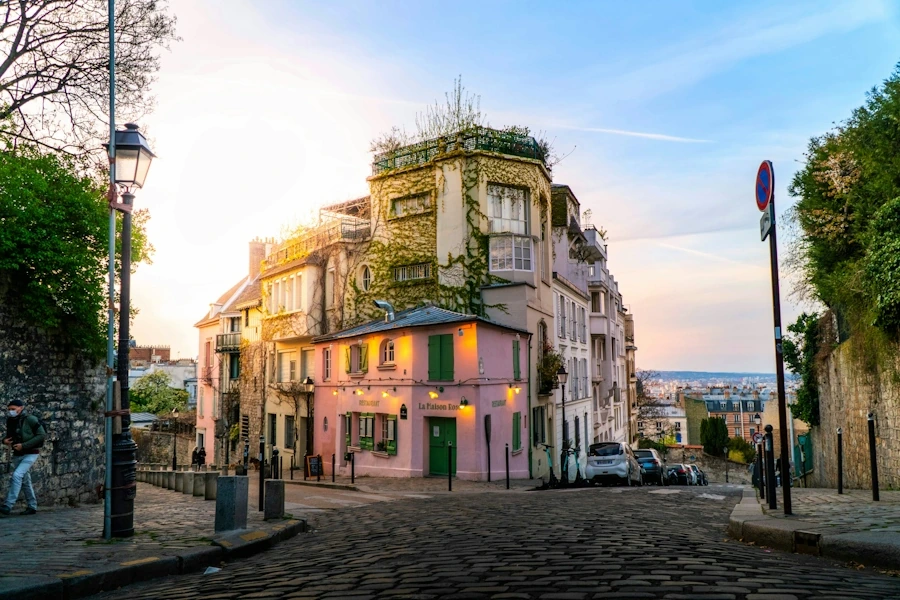
After the museum, choose a downhill direction using a current walking map and your next transport or meal as the endpoint. You do not need a lane-by-lane treasure hunt. Notice how the scale and mood shift away from the busiest summit spaces: doorways, ordinary shops, bends in the street, and the repeated interruption of the skyline by nearby buildings. These are observations to make for yourself, not promises that every corner will be empty or picturesque.
Public streets are enough. Avoid entering residential courtyards or standing in doorways to improve a composition. If a particular place is crowded, keep moving and look for another legitimate pause. Montmartre does not become more meaningful because you have secured an unobstructed photograph of a house. Its interest is the relationship between geography, cultural history, and an inhabited neighborhood. That relationship is easier to notice when you are not fighting for a single view.
Sit down before choosing another activity
A café or meal near your descent route makes a sensible final anchor. Read the menu and choose a setting that fits the time you actually want to spend. If the group needs a long rest, a quick takeaway may postpone rather than solve the problem. If everyone wants to continue exploring, a lighter stop may be enough. My preference would be to decide after the museum, when you know how much attention remains.
Do not expect the café to confirm a romantic story of Paris on demand. A good drink, a clear price, and a comfortable seat can be perfectly sufficient. Use the pause to look back over the afternoon: did the view, the studio, or the garden make the strongest impression? That answer can guide another day in the city. Someone drawn to the studio may want more artist museums; someone drawn to the descent may simply need more neighborhood time.
A hill that rewards a second visit
For a half day, the basilica area and museum are plenty. For a shorter outing, choose one and preserve a little street time around it. Check museum and basilica information separately because their purposes and access arrangements differ. Keep one practical exit route in mind, particularly if darkness or poor weather changes how you feel about walking downhill. Montmartre can be an easy pleasure when you let its geography determine a realistic scale.
Leave the remaining addresses for another visit. The hill's familiarity in photographs can create an unreasonable expectation that one afternoon should produce a definitive experience. It does not need to. You have seen Paris from above, entered a more specific artistic story, and returned through a neighborhood at human scale. That is a complete arc for a day, and a much better reason to come back than a checklist with three unfinished boxes.
Sources & further reading
First published 18 October 2026. Page updated 19 October 2026. Planning references checked on 18 October 2026. The edition date above follows your device’s time zone; it does not indicate a new research check. Confirm current opening details and booking arrangements with the places you plan to visit.