
THE SHORT VERSION
- Choose a specific route section with confirmed transport at both ends.
- Pair the road with one archaeological site rather than several rushed entries.
- Use regional-park information for surfaces, access, and current conditions.
A road can be the attraction
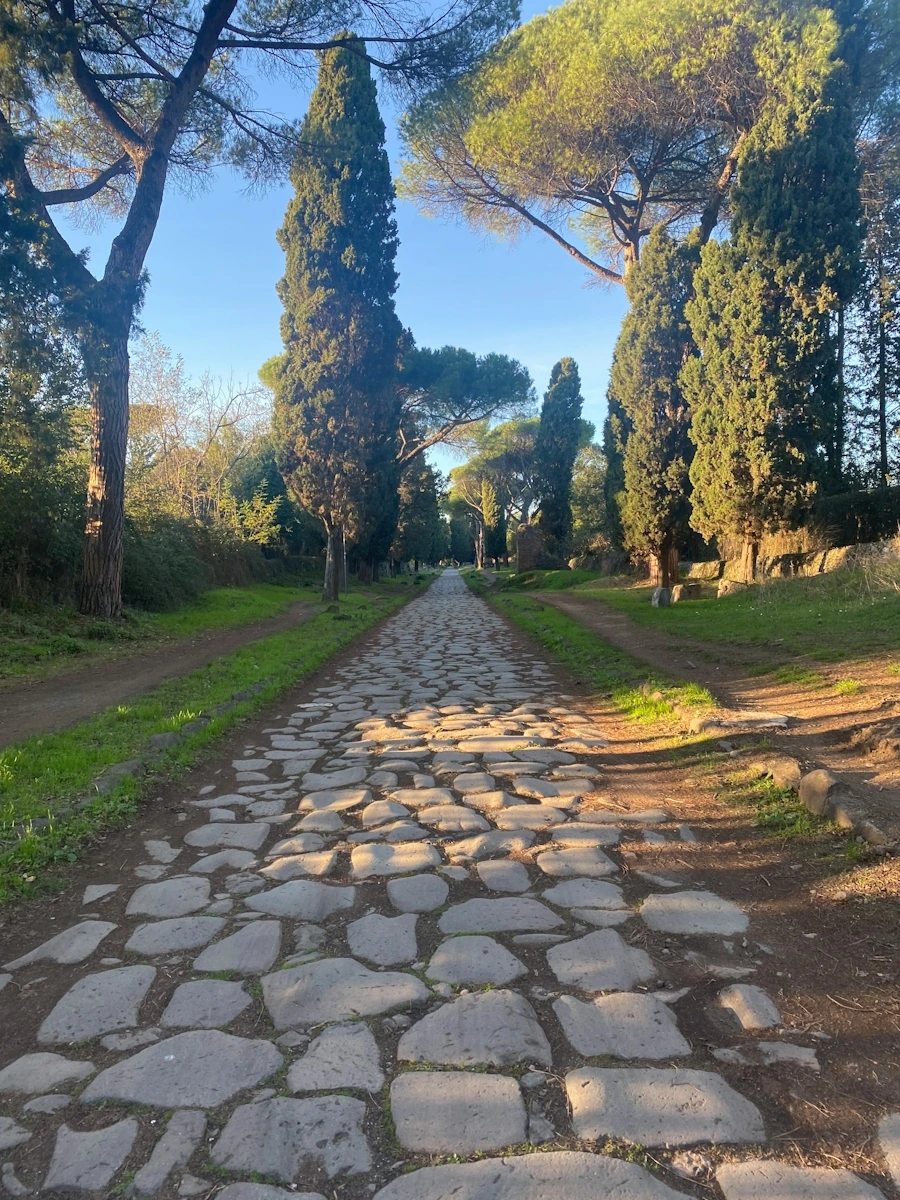
The Appian Way offers a different ancient Rome from the crowded monumental center. Here the subject is a road and the landscape around it: paving, tombs, walls, and stretches of green that allow history to feel spatial rather than confined to a single building. I would give it a separate half day or longer, depending on transport and the section you choose. It is not a quick addition after the Colosseum simply because both belong to antiquity.
Rome's tourism office explains that the road began in the fourth century BCE and later extended toward southern Italy. You only need a short section to understand why that continuity matters. The pleasure is to follow a line that once connected places far beyond the city, then look at the structures arranged beside it. Choose a route through the regional park's current visitor information and make the practical boundaries clear before starting.
Select the section, not an impossible total
The Appia Antica landscape covers a large area. Identify an arrival point, an archaeological stop that interests you, and an endpoint served by a journey you understand. Do not assume the whole historic road is a single pedestrian promenade. Conditions vary, and some stretches involve traffic or surfaces that demand care. A current map and official route guidance are essential to choosing a section that matches your mobility and confidence.
My preference for a first visit would be a shorter walk with one substantive stop rather than a long distance punctuated only by photographs. That allows you to appreciate the road's setting and actually investigate something beside it. If you want to cycle, research a suitable route and rental arrangement separately. Ancient paving and mixed conditions can make cycling a different undertaking from a casual ride through a city park.
Look closely at the paving
The tourism office describes the surviving basalt blocks as basolato. Where these historic surfaces are visible on your chosen route, notice their size, irregularity, and relationship with the road's edge. A road is engineering, not just a picturesque line through greenery. Think about drainage, movement, and the different users it once served. You can begin to appreciate its physical demands without attempting to reconstruct every stage of its long history.
Choose secure footing and look while stopped rather than trying to examine the surface continuously as you walk. The stones are part of what makes the experience distinctive, but they also change how the route feels underfoot. Comfortable shoes with grip matter more than a stylish outfit for the photographs. If the surface does not suit someone in the group, shorten or alter the route rather than treat discomfort as a necessary price of seeing ancient Rome.
Choose one monument to understand
The official Rome itinerary identifies sites including the Tomb of Cecilia Metella, the Villa of Maxentius, and catacombs along the broader road. They offer different stories and visit arrangements. Choose one according to your interest and confirm its current access through the relevant operator. A tomb, an imperial complex, and a catacomb visit are not interchangeable experiences simply because they appear near the same line on a map.
For a first outing, I would choose the place whose purpose you most want to understand. Read a little before arriving, then look for the relationship between structure and road. Why is it here, what impression would it make on someone passing, and what survives to support the interpretation? Those questions keep the stop connected with the walk rather than turn it into an isolated ticket that interrupts the landscape.
Let open space remain open space
Between monuments, give the setting time to work. Look at the proportion of road to vegetation, the distance between structures, and the way walls interrupt or frame a view. You do not need a named landmark every few minutes. The intervals are what distinguish this outing from central Rome. A road through a wider landscape allows the mind to grasp distance and approach, subjects that are harder to feel inside a densely visited archaeological enclosure.
Bring a small notebook if that helps you slow down. Sketch the road's line, write a question about a monument, or note how the surface changes. The exercise can be very simple. It is meant to keep attention in the place rather than turn the walk into work. If traveling with someone, walk quietly for a short stretch and compare what caught your eye afterward. Different observations can make a modest route feel surprisingly rich.
Food and water need a little forethought
Before leaving the city center, check where services are available on your selected section. Carry water appropriate to the conditions and avoid assuming a café will appear at exactly the moment you want lunch. A simple snack can make the walk more flexible, while a planned meal near a confirmed arrival or departure point can give it a satisfying frame. Keep food arrangements proportionate to the route rather than pack as if you were leaving civilization for several days.
If you want a restaurant stop, check its current opening and location independently. An appealing address on a travel map may not fit your walking direction or day. I would prefer to finish the main walk before a substantial meal, unless the schedule of a booked archaeological visit makes another order more sensible. Either way, leave enough room to eat without calculating whether the next connection will depart before you reach it.
Respect the landscape's practical limits
Follow official paths and access instructions around archaeological sites and natural areas. The presence of open land does not make every field, wall, or side track public. Check the regional park's notices for works, closures, events, and route conditions. This is useful planning rather than an obstacle to enjoyment. Knowing which section is suitable lets you relax into the walk instead of repeatedly wondering whether you have wandered somewhere you should not be.
Allow for the actual weather. An exposed route can be tiring in heat and uncomfortable in rain, while uneven paving asks for more attention when wet. If conditions do not suit the outing, choose a museum day and return when the road is more inviting. The Appian Way will not lose its appeal because you give it a better day. A flexible decision can preserve both your comfort and your interest.
Turn back with something understood
Finish at the point you planned, or earlier if the walk has given you enough. A return along the same road is not wasted distance: the direction of approach changes, and familiar structures become easier to place. Use the journey home to connect one physical detail with one historical idea. A basalt surface and the problem of movement, for example, can be a more durable memory than a list of monuments encountered without context.
The ideal first visit leaves an appetite for another section, not the feeling that you have walked until the scenery stopped mattering. The Appian Way is a reminder that Roman history involved routes, edges, and landscapes as well as monumental centers. A carefully chosen stretch gives that wider world room to appear, and makes returning to the busy city afterward feel like entering a different chapter of the same story.
Sources & further reading
First published 18 October 2026. Page updated 19 October 2026. Planning references checked on 18 October 2026. The edition date above follows your device’s time zone; it does not indicate a new research check. Confirm current opening details and booking arrangements with the places you plan to visit.