
THE SHORT VERSION
- Visit Trastevere in the afternoon and let dinner be the ending.
- Use Villa Farnesina or one church as a clear cultural anchor.
- Check the return route before settling into the evening.
Arrive before the dinner decision
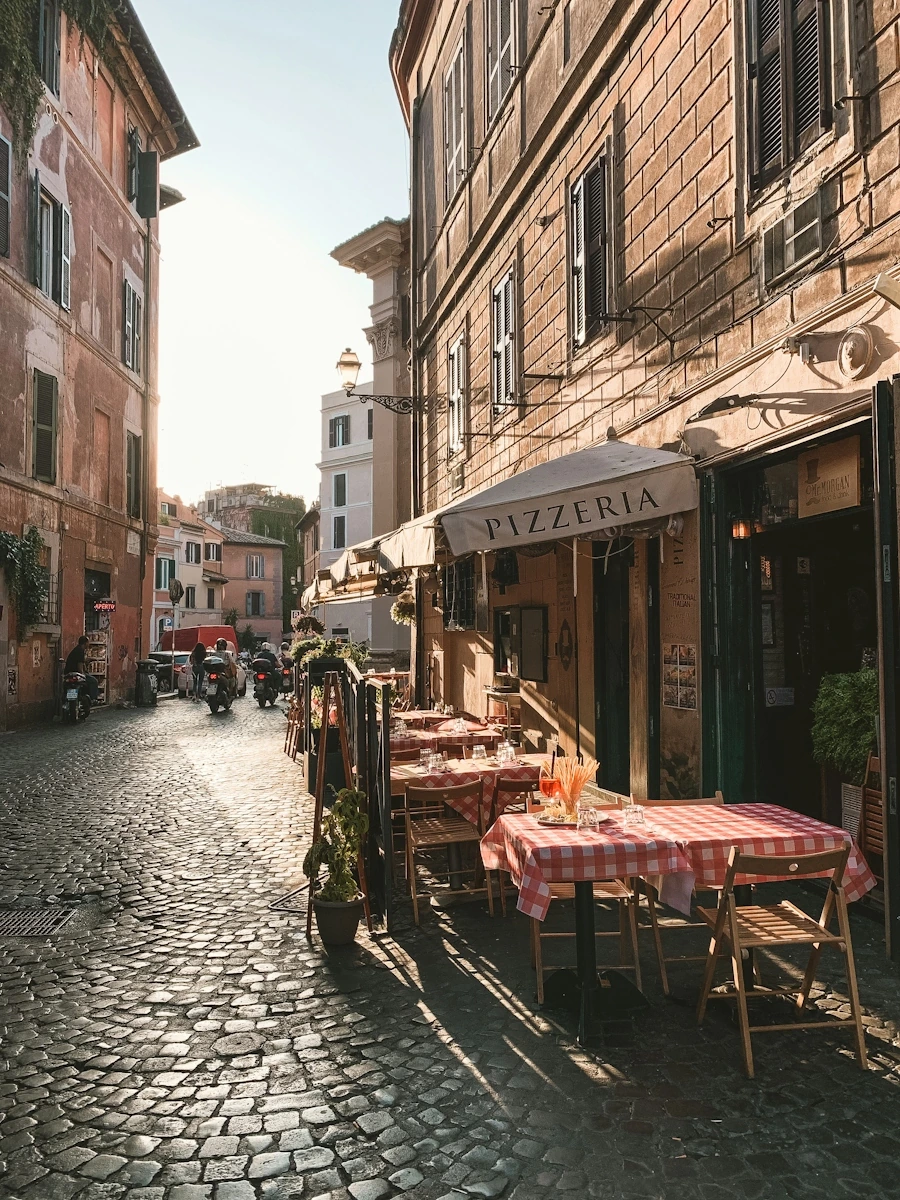
Trastevere often appears on Rome itineraries as the answer to where to eat in the evening. I would arrive earlier and let food become the ending rather than the entire purpose. The neighborhood offers enough art, architecture, and public-street wandering to fill an afternoon with its own shape. Choose Villa Farnesina or a church-focused route as the anchor, then make room for a square, a pause, and dinner if you still want it.
This approach also takes pressure off the restaurant choice. When the whole outing depends on securing one supposedly essential table, the neighborhood can become a queue surrounding a meal. Arrive with something else to enjoy and you can choose food more calmly. Trastevere is not a performance of old Rome waiting for visitors; it is an inhabited district with cultural sites, commerce, and ordinary routes. Looking at that mix is more rewarding than trying to find a perfectly timeless street.
Villa Farnesina supplies a clear beginning
Villa Farnesina is the first choice I would consider for an art-led afternoon. Rome's tourism office places it in Trastevere and emphasizes its Renaissance architecture and painted interiors. The villa's own information describes a visitor route that includes spaces associated with Raphael and other artists. Check what is open for your date and choose the visit because the paintings and rooms interest you, not merely because an elegant interior seems necessary in Rome.
Give the building time as a whole. Notice how painted surfaces interact with actual architecture, and how a room directs your body as well as your eye. A fresco is different from a picture that can be moved to another wall. Look for the relationship among doorway, ceiling, light, and painted illusion. You do not need a complete mythology lesson before entering, but a little interpretation can make specific scenes much easier to follow.
The villa's published visitor route names the Loggia of Galatea, Loggia of Cupid and Psyche, and Perspectives Hall among its spaces. If painted illusion particularly appeals to you, use those titles as prompts for research before arriving. That gives the visit a concrete theme without requiring you to chase every possible Renaissance interior in Rome.
Look at a room twice
A useful method is to take one room in broadly before reading every detail. Then choose a small area, learn what it represents, and look again at the whole. The return view can reveal how the composition works rather than leave you with isolated facts. If you have a guide or audio interpretation, pause it occasionally. Good information should help you look, not keep you staring at a screen while the room waits around you.
Follow the villa's current rules on photography and recording. The visit does not become less personal because some of it remains unphotographed. A note about a color relationship or a painted architectural effect may preserve the experience more clearly than a rushed image of the entire ceiling. Afterward, take a short outside pause before returning to the streets. A little distance helps the interior stand apart from the rest of the afternoon instead of becoming one more stop in a continuous sequence.
Follow the public streets toward a square
Use a current map to connect your cultural visit with Santa Maria in Trastevere or another chosen public square. Let the route remain modest. The neighborhood's small streets reward looking at changes of scale, entrances, and the sudden opening of space around a church. You do not need a prescribed sequence of photogenic lanes. A simple connection gives you enough direction to relax while leaving room for a bookshop, a café, or an architectural detail that actually catches your attention.
Keep doorways clear and avoid treating residential courtyards as public scenery. If a street is crowded, move through rather than waiting for everyone else to disappear. The inhabited quality is part of what you came to see. I would put the phone away for a short stretch and notice how the route feels underfoot and how your view changes at each turn. Those impressions often distinguish a neighborhood more clearly than another photograph of a narrow lane.
A church visit changes the pace
Santa Maria in Trastevere and Santa Cecilia are among the cultural sites identified by Rome's tourism office. Choose one according to your interest and check current visitor access, which may be affected by worship. A church is an active place with a purpose beyond sightseeing, so enter with the appropriate conduct and enough time to be quiet. The change from street activity to a more concentrated interior can become the afternoon's strongest contrast.
Look at the room's overall organization before searching for particular artworks. Where does the eye go, how is the central space framed, and what does the light emphasize? Interpretation can add dates and names, but the first response can be visual and spatial. If the church is unavailable, keep the square and street portion of the outing. A plan with several modest pleasures can remain worthwhile when one interior cannot be visited.
Dinner should follow your appetite
When it is time to eat, choose the meal you want rather than the reputation attached to an address. Read the menu, check prices and booking conditions, and ask about unfamiliar dishes. A restaurant serving a focused selection can be easier to enjoy than a place promising everything. If a particular table matters to you, reserve through the venue's own channel and fit the afternoon around it. Otherwise, leave enough flexibility to choose after seeing the area.
I would avoid ordering several rich dishes simply because each is described as a Roman essential. One pasta, a vegetable dish, or another manageable meal may be exactly right after walking. Discuss sharing and budget before ordering with a group. Dinner can be a generous close to the afternoon without turning into a test of how completely you have sampled the city's cooking. Save other dishes for another day, when appetite can give them proper attention.
Leave by a route you understand
Before settling into the evening, check the practical journey back. The river offers clear orientation, but transport stops and crossings still need current directions. A relaxed dinner is easier to enjoy when you are not vaguely hoping that the route home will explain itself later. If tired, take the simplest available option. There is no requirement to add a long nighttime walk after an afternoon already rich in interiors, streets, and food.
For a shorter visit, choose Villa Farnesina and a square. For a fuller afternoon, add one church and dinner. Keep the art, neighborhood, and meal balanced so none feels like waiting for another. Trastevere becomes more interesting when you give it daylight and curiosity as well as an evening appetite. You leave with rooms, routes, and a few specific observations, rather than only an opinion about where you managed to get a table.
Sources & further reading
First published 18 October 2026. Page updated 19 October 2026. Planning references checked on 18 October 2026. The edition date above follows your device’s time zone; it does not indicate a new research check. Confirm current opening details and booking arrangements with the places you plan to visit.