
THE SHORT VERSION
- Keep one day focused on Ubud and its immediate surroundings.
- Use an art institution to add context before shopping.
- Treat ridge paths and rice fields as real landscapes with access limits.
Give Ubud a day that belongs to one area
Ubud is often used as the starting point for an ambitious circuit of rice terraces, waterfalls, temples, swings, and cafes. That can mean much of the day is spent on the road. I would give the town and its immediate surroundings a quieter day first. Choose an art-focused anchor, a manageable walk, and a meal with time to sit. You do not need to travel to every famous view to appreciate Bali’s inland character.
Start by understanding where your accommodation actually is. A hotel described as Ubud may be far enough from the center that walking is not a practical first step. Plan the arrival and return with a suitable driver or other legitimate transport option, and avoid assuming a road on the map has a continuous safe footpath. Compact distances can still be awkward beside traffic.
Let an art institution provide context
A museum such as Museum Puri Lukisan or another established art venue can give the day more substance than a sequence of decorative shopfronts. Check the institution’s current collection and visiting information, then choose a few works to examine closely. Look at how figures, landscape, color, and narrative are arranged. Reading a label can help you distinguish an individual artistic choice from a generic image of Balinese style.
Do not feel that you need to understand every tradition before entering. Curiosity and attention are enough to begin. If a guide or staff member is available to explain something, ask a specific question rather than requesting a complete history in a few minutes. A focused conversation about one work can stay with you longer than an overwhelming quantity of facts.
Choose a walk with honest expectations
The Campuhan Ridge area is a possible walking choice when current conditions suit, but treat it as a real outdoor route rather than a flat garden path. Check the approach, surfaces, heat, and your return before setting out. Early or later daylight may be more comfortable than midday, yet the best time is still the one that fits weather and safe visibility. Stay on public, permitted paths and do not enter planted fields for a photograph.
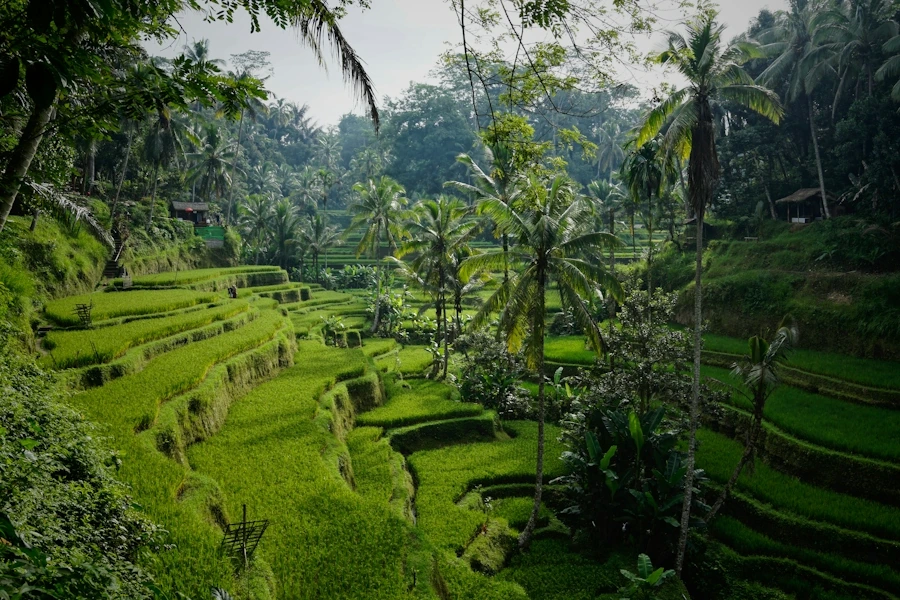
Rice landscapes are working places. Terraces, channels, and narrow boundaries are not simply scenic furniture for visitors. If you visit a managed landscape elsewhere around Ubud, use the recognized access and pay any legitimate entry requested by the operator. Ask before photographing someone working close up. A landscape can be beautiful without requiring a person to become part of your composition.
Spend the evening on something chosen
For the later part of the day, choose a performance, a meal, or another slow cultural stop according to what genuinely interests you. If a dance performance is the focus, check the actual program and ticket arrangements rather than assuming that the same show happens every night in the same place. Arrive with time to sit and understand what you are attending. It is worth more than an activity squeezed between two dinner reservations.
Avoid framing every inconvenience as evidence that you have not found the real Bali yet. Ubud is a lived-in and much-visited place, with traffic and commercial activity as well as art and landscape. A thoughtful visit works within that reality. You can enjoy a carefully chosen gallery, a short walk, and an ordinary lunch without needing to claim a secret route to an untouched island.
Keep the road from becoming the main attraction
The first Ubud planning question is the address of your accommodation. A property marketed as Ubud may be beyond a comfortable walk from the center, and roads can lack a continuous footpath. Confirm the approach and return before choosing a museum time or evening performance. If a driver is involved, agree on the relevant destination and meeting arrangement rather than assuming a vague instruction to return to Ubud will be enough. A smaller day in one area can then become genuinely relaxed instead of merely replacing one long road journey with several short uncertain ones.
For an art anchor, investigate the current visitor information of the institution you choose, such as Museum Puri Lukisan. Check what is on display and whether it matches your interest. Inside, look at one work long enough to notice composition, material, and narrative detail. Then use the label or an available explanation to test your impression. You do not need to call every piece traditional or timeless. Artists make particular choices, and recognizing one of those choices gives the visit more substance than collecting a general mood. Ask permission before photography where the rules are unclear.
A walk around Campuhan should be assessed as an outdoor route with a specific approach and turnaround. Check local conditions, surfaces, and whether the public access is clear. Do not promise yourself a solitary green ridge because of a carefully framed image. Other walkers, nearby buildings, and weather belong to the experience. Remain on the available path, turn back before conditions become uncomfortable, and avoid stepping into fields to remove another person from your frame. The landscape does not become more real when you cross a boundary that was intended to keep visitors out.
If you visit another rice-growing area, ask how access is managed and respect the work that continues there. Water channels, crop edges, and narrow terraces serve practical purposes. They are not general walking shortcuts. A legitimate managed entrance may make the visit easier to understand, but it does not erase the need to follow the designated route. Consider whether you want interpretation or simply a view, then choose accordingly. You may find that a shorter encounter with clear context is more satisfying than a long drive between several landscapes whose differences you never have time to notice.
For the evening, decide whether a performance or a meal matters more and give the chosen event room. Check the current program, ticket, and place of arrival. If you attend a performance, learn what the program says about it rather than applying a generic description to everything you see. If you choose dinner instead, enjoy the pause without treating it as time lost from culture. Ubud offers enough complexity to reward an ordinary day: a selected artwork, a walk that suited the conditions, and a meal that did not require another hurried departure.
A performance deserves its own attention
If a dance performance is your evening choice, read the program before it starts and keep enough time afterward that you are not watching the final section while arranging a pickup. Follow the venue’s camera rules and remember that seeing through a phone is a different experience from watching directly. You do not need to document the full sequence to remember the movement, costume, or sound. A few notes afterward may help more. This allows the performance to stand beside the day’s art and landscape as a chosen cultural encounter, rather than the last activity squeezed into an already crowded Ubud itinerary.
Sources & further reading
First published 18 October 2026. Page updated 19 October 2026. Planning references checked on 18 October 2026. The edition date above follows your device’s time zone; it does not indicate a new research check. Confirm current opening details and booking arrangements with the places you plan to visit.